
Wave and Ethernet L2 Options for Private Point-to-Point Connectivity
June 8, 2026 by Cogent Solutions Engineering
In general terms, both Wave and Ethernet L2 address the same customer need of a private dedicated point-to-point connectivity between two customer locations. Customer has two locations far apart from each other, both Cogent services connect the two locations across the wide area network as if they were connected by an Ethernet cable.
Both services are completely secure and private to each customer, for both services Cogent makes sure the contracted bandwidth is available to the customer and both services are supported by Cogent operational standards and industry leading SLA. Both services are compliant to the Ethernet standards and allow for connections not only between customer sites but also to customer Cloud instances, such as AWS, MS Azure, Google and others.
Customer requirements vary by a number of factors: speed, geography, topology and number of sites, application requirements to name a few. Each of those elements, depending on their importance to the specific customer application, carry a role in the customer solution decision process, with Cogent available for advice and guidance throughout the sales process.
With respect to speed, we see that for Cogent customers at the moment 10Gbps is the typical cross-over point: for connectivity requirements less than 10Gbps customer like the flexibility of Ethernet L2 services with a granular control of the Committed Data Rate (CDR), while for connection speeds significantly higher than 10Gbps Wave services typically offers a better cost basis. This cross-over point is evolving over time, few years ago Cogent competitors used to sell lower speed waves, this is rarely the case nowadays, especially in the long-haul market.
With respect to geography, the cost-effectiveness of Wave services is typically confined to the extent of the infrastructure of the infrastructure provider. Cogent, as very few of our competitors, has extensive coverage and owned assets across the entire of North America. Other carriers focus on their respective home markets, for example with networks across Europe. For high-speed connections in a given region, like North America, Cogent customers often prefer Wave services; however when the requirements spans multiple regions, Ethernet L2 options are often considered favourably by Cogent customers, like for connection from North America to other continents.
Some customers prefer Cogent Wave services when they require strict control over each network segment used to build their network, with each wave following a fixed pre-defined path and with the option to add as many redundant wave paths as needed; some perceive Wave services as a building block to build their own network infrastructure at the transmission level with complete control over the L2 functions. Other customers prefer the flexibility of Ethernet L2 connections, releasing to the Cogent data backbone the determination of optimal routing and redundancy.
Customer topology also drives the customer decision process: Ethernet L2 services start from a point-to-point configuration as the Waves services, however Ethernet L2 services can also be configured to support large one-to-many and any-to-any topologies in a more cost effective way.
Applications requirements can be very specific and are too many for a comprehensive description. One example: Cogent customers in the financial trading business find very valuable the ability of wave services to lock down the physical path of their connections because their applications require the lowest possible transmission delay and are extremely sensitive even to occasional sub-millisecond delay variations.
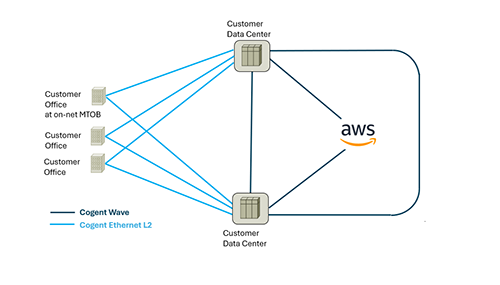
All those elements come together in driving customer choices: a customer connecting an handful of datacenters and/or cloud locations in North America at 100Gbps speed and above, they would naturally lean towards Wave services. A customer connecting several dozen sites at 1 to 10 Gbps, with any-to-any connectivity requirements would naturally lean towards Ethernet L2 services; even more so if any hard to reach location is included in the customer network. Anything in-between might need a design review and might result in a combination of different services within the overall customer solution. The example below shows a customer network, with two major datacenters connected to each other and to AWS with multiple diverse Wave services, while multiple offices access corporate resources at the datacenters using Ethernet L2 services.
About the Author:
The Cogent Solutions Engineering team is a group of experienced, technically-versed and business-minded individuals who understand the challenges facing our global customer base, and how Cogent’s set of products and services can address these, from their daily involvement in customer conversations, review of individual customer requirements, solution design, and resulting product development initiatives.